
Eight Feature Recommendations from ND/NF 2026, From an IFFR Winner to Charli XCX’s Indie Debut
Variations on a Theme
by Nelson Kim in Festivals & Events
on Apr 8, 2026
Brand New Landscape, Charli XCX, Clemente Castor, Cold Metal, Devon Delmar, Erupcja, If On a Winter's Night, Jason Jacobs, MEMORY, New Directors/New Films 2026, Next Life, Pete Ohs, Sanju Surendran, Strange River, Variations on a Theme, Vladlena Sandu, Yuiga Danzuka
New Directors/New Films, the annual showcase for emerging filmmakers co-presented by Film at Lincoln Center and the Museum of Modern Art, runs from April 8 to 19. Now in its 55th edition, ND/NF can boast of having screened the early films of generations of globally renowned directors, fromWim Wenders, Theo Angelopoulos, Steven Spielberg, James Benning, andChantal Akermanin its first several years, toYorgos Lanthimos,Laura Poitras,Kleber Mendonça Filho,Ryûsuke Hamaguchi, andRaMell Rossmore recently. Most of the festival’s selections arrive by way of fests such as Berlin, Busan, Cannes, Sundance, Locarno and Venice, and as usual, there’s no shortage of adventurous, audacious work on display. From the 24 features and 10 shorts that make up the 2026 slate, I’ve chosen eight features to spotlight, with assists from previousFilmmakerwrite-ups by Alex Lei, Scott Macaulay, Cici Peng, and Vadim Rizov. The films are listed roughly in the order they’ll screen at the festival.
One of ND/NF’s highest-profile offerings this year is Pete Ohs’Erupcja, which teams the prolific microbudget auteur with the pop sensation Charli XCX, here playing a British tourist who reconnects with an old friend on a trip to Warsaw.Scott Macaulay wrotebefore the movie’s premiere in Toronto last September: “Ohs makes one film per year with tiny crews—he’s his own DP, sound recordist and editor—and stories developed collaboratively with his actors…It’d be natural for Ohs to be tempted to scale up his…model after casting the world’s biggest pop star in one of the lead roles. For Charli, it’d be obvious to proceed with caution, to perhaps insist on traditional development, a bigger crew, and to push the project until after her tour. Fortunately for all of us, neither took the traditional path, andErupcja’s many considerable strengths—its beautifully natural performances (Charli makes a fantastic screen debut here, and she and [Lena] Góra have a lovely chemistry), its subtle and relaxed dramatization of characters whose inner lives are often opaque to each other, and its freewheeling depiction of Warsaw youth culture—are inseparable from the purity of its making. Five features in, Ohs has finely honed his method with this new picture, expanding his canvas both in terms of location but also theme and emotional expression….Erupcjawill touch any romantic who’s gone on a trip to a place that can make you change.”
The Catalan director Jaume Claret Muxart’s lyrical, shape-shifting debut featureStrange River premiered at Venice and went on to screen at San Sebastián, Busan, Reykjavík, and Chicago. Vadim Rizovwroteabout it last October: “[F]or 40 minutes…Strange Riveris a fine but familiar coming-of-age saga rooted in a flawlessly naturalistic Catalan family unit on a financially straitened summer vacation biking alongside the Danube through Germany. 20 years ago, this movie would probably have been about a queer teen angsting about coming out; in a sign of meaningful social change within my lifetime, 16-year-old Dídac (Jan Monter) already has his loving family’s full and uncompromising support. The film is, nonetheless, on pretty standard ground until it takes a few unexpected turns…Didac [splits] from both his family and the narrative entirely, running away with a young German teen (Francesco Wenz) on a boat cruise down the Danube towards his own hopeful erotic realization. As the initial structure disappears entirely, both he and the narrative are liberated to pursue unexpected paths in a first feature that leaves more of an impression than it initially promises.”
A Tibetan-American family—elderly parents, grown son—confront the father’s imminent death in Tenzin Phuntsog’s contemplativeNext Life. The family lives in middle-class comfort in a Northern California suburb, but the father yearns to return to Tibet to die. Phuntsog (who shot the film in his family’s house and cast his own mother to play the matriarch) steeps us in the rituals of Tibetan Buddhism, which provide spiritual comfort even in the face of unbearable loss.Next Life’s meditative pacing won’t be to every viewer’s taste, but if you’re in a receptive mood, as I was, you might find yourself entranced by the film’s gentle rhythms, and moved by its graceful exploration of love and death. Alex Lei wrote in hisreporton the Maryland Film Festival last November: “There is a spiritual flow between things which Phuntsog brings out through his sparse mise-en-scene, highlighting both a pain buried deep in the past and the literally heartbreaking absence felt by the characters who physically cannot connect with their homeland. As Rigzin attempts to get his father’s visa application to Tibet approved by the Chinese embassy, while simultaneously preparing Pala for his passing, Phuntsog gorgeously, tragically explores spiritual possibilities transcending the bureaucracies which hold us back.”
Sanju Surendran’sIf on a Winter’s Nightis a drama about idealistic young lovers crashing against the rocks of economic hardship. Sarah and Abhi are a Malayali couple from Kerala who have moved to Delhi in search of creative fulfillment and, in Sarah’s case, escape from an overbearing patriarchal family. She finds work at a film festival, while he tries to scrape together the money needed to mount an exhibition of his artwork. But as bad decisions and bad luck pile up, the life they dreamed of slowly slips out of their grasp. Rizovwroteabout the film for its Busan premiere: “Both lead performers convincingly embody the lived-in quicksilver intimacy of an infatuated couple being slowly worn down, and watching the light slowly fade from their eyes is fairly devastating. One subtext, which the subtitles make clear by always indicating which language is being spoken, is that the couple are non-Hindus relocated to a city in the grip of prime minister Narendra Modi’s xenophobic and nationalistic Hindutva ideology; to hear Hindi spoken is not just alienating but signals a potential threat to their physical safety, a hostility which begins just outside their doorstep. People need space (mental and physical), scope (to dream of progress towards better things) and support (from their workplace and surrounding society): what happens when none of the three are available?”
Brand New Landscape, the first feature by Yuiga Danzuka, begins with a prologue set ten years in the past: an ambitious architect cuts short a family vacation to bid on a major project, leaving his wife and two young children feeling disappointed and abandoned. Then the story jumps ahead to the present: the wife is dead, the husband is an internationally successful landscape designer who hasn’t seen his children in several years, and the now-grown children live with disappointment and abandonment as their daily companions. The father returns to Tokyo from abroad, and attempts to reunite with them, but the pain he caused isn’t easily wiped away. As the title indicates,Brand New Landscapepays close attention to the environments its characters move through; Danzuka’s framing of people in buildings calls to mind great poets of urban alienation like Antonioni and Edward Yang. The film has some rough spots—a brief documentary interlude critiquing the father’s designs for gentrifying once-diverse neighborhoods lands clumsily, and a promising third-act turn to magical realism fizzles out—but the core story of a broken family moving haltingly toward reconciliation carries a quiet emotional charge that lingers afterward.
The Mexican director Clemente Castor’s second feature,Cold Metal, mystifies and intrigues; nearly impenetrable on a narrative level, it nevertheless held my attention with its exploratory approach to cinematic form, shot through with moments of arresting beauty. The story involves two brothers: Mario, who wakes up haunted by “images that don’t belong to him,” and Óscar, who has disappeared from rehab. Castor’s film is driven by seemingly contradictory impulses: he has a documentary-like interest in capturing the voices, bodies, and gestures of his non-professional actors and the everyday reality of the movie’s setting (the working-class Mexico City Iztapalapa suburb), while at the same time imposing a heavily aestheticized style: non-linear editing, startlingly off-kilter sound design, a freewheeling mixture of film stocks and shooting styles. After seeingCold Metalat FIDMarseille last July, Cici Peng wrote that “Castor’s work is often aggressively opaque, guided by a seemingly haphazard editing logic that deliberately short-circuits narrative momentum as the film drifts between non-fiction, epistolary voiceover, gestural performance and the supernatural, staged by a largely non-professional cast. Although I can’t say I understood everything, I felt so surprised by the sensation of being adrift, teleporting between ever-shifting film textures and terrains, from the underground to the skies of what appeared like the edge of the world. The film’s dialectics aren’t strictly ideological but affective: like Mario, I found myself clinging to signs, grasping at symbols, trying to decode meaning from disorder in an almost schizophrenic mode before suspending any desire for formal cohesion.”
A few years ago, Iwrotethat New Directors/New Films “is a festival for audiences willing to let directors try things out. You won’t get a masterpiece every time you buy a ticket—but you will be rewarded with films that are almost always interesting and worthwhile experiments.”Brand New LandscapeandCold Metalfit that description perfectly: films that didn’t completely land for me, but excited me with their makers’ ambition and willingness to explore the boundaries of the medium. The two movies that most impressed me from this year’s slate,MemoryandVariations on a Theme, were something more than that. Masterpieces? Time will tell. But at the very least, they’re fully realized visions by mature artists. Both are hybrid documentaries that deploy fiction-making techniques in enchanting and original ways, and both use the hybrid form to interrogate history, politics, and how we make sense of the world.
Vladlena Sandu, the director and narrator ofMemory, was born in Crimea and was sent to live in Chechnya with her grandparents after her parents split up when she was six. Chechnya declared independence from Russia following the dissolution of the Soviet Union, but in two bloody wars in the 1990s and early 2000s, Russia regained control of the country. Sandu reconstructs those years—the years of her childhood and adolescence—inMemory, but her telling of the story is delivered to us via two channels, so to speak: We hear the adult Sandu dispassionately recounting what she lived through, while we see the child Vladlena’s version of the same events—candy-colored, fantastical, dreamlike. Day-long treks for a loaf of bread, dead bodies littering the streets, bombs falling from the sky. To the little girl who experienced such things, they were simply part of life, but the grown-up survivor understands the trauma they engendered. The childhood-memory tableaus are exquisitely rendered, reminiscent of the storybook quality of Wes Anderson’s films, or Sergei Parajanov’sColor of Pomegranates, but Sandu intercuts them with family photos and news footage of the war, rude eruptions of reality breaking through the perfectly composed frames. Woven throughout the story is Sandu’s relationship with her abusive grandfather, a throwback of a man who takes pride in his own pettiness, prejudices, and small-mindedness. The young Sandu hates and fears him; the older narrator traces his cruelty back to his own childhood traumas, an act of intergenerational empathy that’s central to the film’s theme of innocence lost and that loss being (somewhat) redeemed through understanding.Memoryis a cinematic autobiography—and a war movie—unlike any I’ve ever seen.
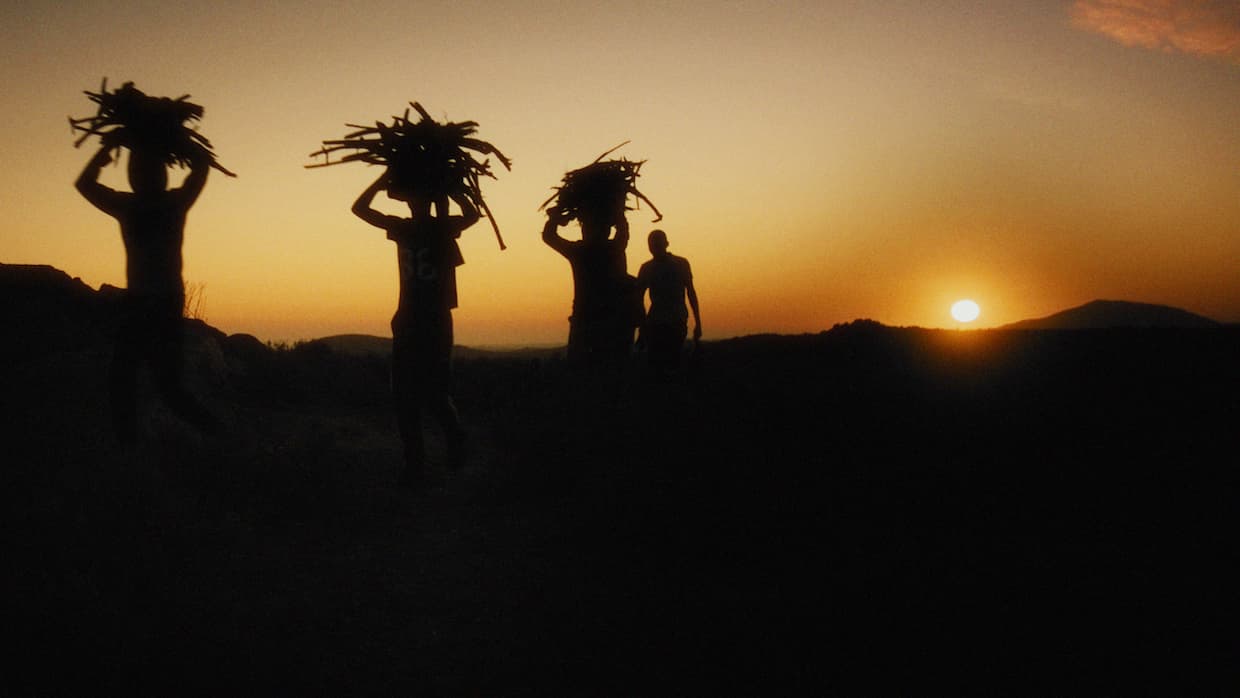
Jason Jacobs and Devon Delmar co-wrote and co-directedVariations on a Theme, whose central subject is Jacobs’ grandmother Hettie Farmer, an elderly goat herder in a rural South African village. Farmer’s father was one of thousands of Black South Africans conscripted to fight in World War II; at the end of his service, he received a bicycle and a pair of boots. White veterans were given land and cash. This grave inequity, compounded over decades and generations, lingers in both the memories and the strained living circumstances of the Black veterans’ descendants, making them easy prey for scam artists who claim that for a small administrative fee, the descendants can win reparation payments from the government. History repeats itself, as the villagers wait in vain for justice for their ancestors, while falling victim to injustice in the present. And yet, the 65-minute running time ofVariations on a Themeis filled with wonder, kindness, and the loving bonds of family and community. Jacobs and Delmar enlisted the villagers to play themselves, or fictionalized versions of themselves, and collaborated with them to develop the multiple plotlines. The result—the deserving winner of the top prize at Rotterdam—plays like a series of short stories woven into a tapestry telling the collective tale of a people. Jacobs and Delmar shoot in wide-open frames that take in the gorgeous mountain landscape; the compositions repeat themselves, with subtle variations, over each of the five days of story time, a structuring device that speaks to both the villagers’ hope for better days ahead, and their knowledge that very little will change.
Source: filmmakermagazine.com