
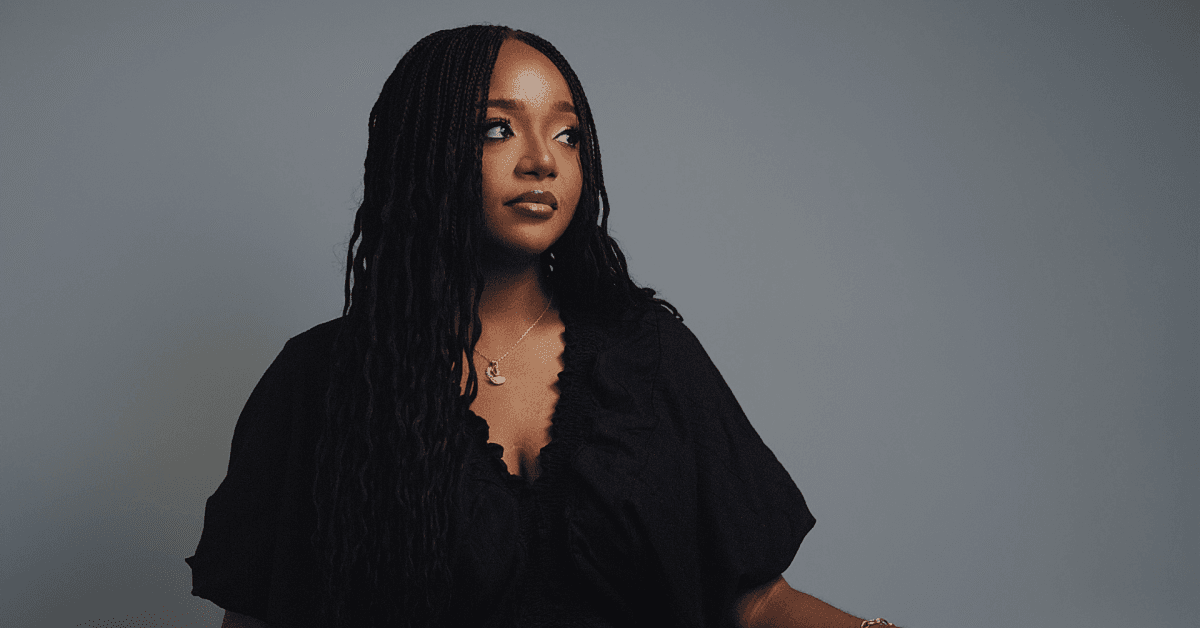
After writing and developing projects including Battleground, Riona, MTV Shuga Naija 5, Slum King and Chetam, Gimsay makes her feature directorial debut with Black Market, a character-driven crime drama following three market women whose smuggling operation pulls them into an increasingly dangerous world. Produced by Nora Awolowo’s Rixel Studios, the film brings together Gimsay’s interest in complex, flawed women with questions of survival, economic pressure and the realities of contemporary Nigeria.
With an ambitious 50,000-person Lagos screening also aiming to set a Guinness World Record, Gimsay explores the making of Black Market, writing women beyond easy archetypes, the possibilities of community cinema, and why culturally specific Nigerian stories remain at the heart of her work.
Please introduce yourself … Hi, my name is Fatimah Binta Gimsay, actually Nana-Fatimah Binta Gimsay. I am Nigerian, from both Edo and Plateau State.
Describe your life in one word or a sentence… Delicious.
Why are we here? We are here to be curious and explore our curiosity. I think that’s why we are all storytellers. All of humanity is just one big storytelling exercise, but we are also here to talk about Black Market.
Tell us what Black Market is about in your own words. Black Market is a story about a world within a world. It is a story about survival, jealousy, and the socio-economic side effects on the average person. I always say it is about ordinary people living extraordinary lives just for survival.
Where’d this story come from? The general idea came from Nora Awolowo, my producer. We took the idea and developed it into a story together; she had a lot of insight into the market side of things, and we used that to develop a story.
How did your writing process differ from features like Lowkey Adults and Finding Me, or shorts like Ijo, Laraba and Balarabe? I am not a producer here, so there’s less pressure for me, thankfully. With projects like Finding Me, I was brought in halfway through writing to assist with rewriting, so it was a proper work-for-hire gig. With projects like Lowkey Adults, Ijo, Laraba and Balarabe, these are my children. I not only wrote them, but I produced and executive produced, so my writing process was flexible. But I had to be accountable to myself.
With Black Market, we had the encouragement of Nora, who would say what was and was not possible. Writing is amazing, but the budget brings you back to reality, and this is a commercial feature. Most of my personal projects are not exactly commercial, so this was a learning process. I enjoyed seeing things through a new lens.
Were there any story blocks in piecing the world of Black Market together? Yes, we have been very transparent with how brutal the story development process was. We had to be mindful because as much as this is fictional, we are still dealing with real-life themes. We wanted to make a fun film without doing a disservice to the audience as well.
Which parts of the story just flowed effortlessly for you when you were writing? Character dynamics really flowed for me. I love when characters feel like real people, because dialogue feels grounded and fun.
Which character is closest to you and how you see the world? I’d say Aramide, played by Scarlet Gomez. She is the most guarded, most sensitive, and most protective one. People assume she’s a hard babe, but she’s really just fragile and wants to keep her people safe. We see the world in a morally grey way where we both truly dislike authority; I’m truly recalcitrant and very solution-driven rather than stewing, nagging, and being a victim.
A scene or a line that best captures why you agreed to write this. Too much of a spoiler, but a couple of moments made me glad to come on board this project. I think I really like the women’s dynamic. I love showing how women truly interact without the idealistic girl power energy.
What drew you to telling a smuggling story specifically through the lens of market women? It was new and challenging. I love storytelling, and I love stories that are extremely Nigerian; this jumped out at me. I am a Nigerian who grew up in Lagos; I see market women every other day, and it just felt great to tell some of their stories. Nora didn’t have to do a lot to convince me to come on board.
Adesua, Aramide and Zimuzo each have very distinct temperaments. How did you approach differentiating their voices in a manner that would translate and connect properly on screen? This is something we were very careful about, and I do hope it translates to screen. They are completely different women, and we put them on a spectrum. I love character work because I should be able to tell you what would make Zimuzo cringe and what will make Aramide sit up while Adesua minds her business. In writing, you should discuss your characters like real people, and that makes the process smoother. There can be scenarios that don’t even exist in the film, and I automatically know that Zimuzo would get into big sister mode, Adesua would panic, and Aramide would act without waiting for permission.
You share story credit with Nora (Awolowo) and Abdul (Tijani-Ahmed), co-writing the script with the latter. What did that collaborative process look like across three creative voices? It was one of my favourite experiences because we all brought different things to the table. Abdul and Nora had been with a version of the story longer, and I entered like a little creature with my own point of view. I don’t know if it’s the producer or director in me, but as much as I go far with writing, I also like to be practical, so this was helpful for us. Storytelling can be exhausting, but we kept pushing. We disagreed, we agreed, and we found the middle. The goal was to serve the story, and put our feelings aside. Which isn’t easy as a writer, and I wouldn’t be dismissive about it, but with a good team, you learn to find that balance where you can both be attached to your story and also focus on the big picture.
What was it like researching the intricacies of smuggling and the murkiness that characterises the Nigerian border? I am about to sound ignorant and say it was funny. Not in a ha-ha way, but in a way that truly removes a veil from how I see things. Even driving through the road borders after shooting made me feel we cared too much about certain things in filmmaking. No offence, but if you’re driving in or out of Lagos to another ECOWAS country at night, you’re in stark darkness. It is so loose and careless. The barricades are sticks and empty kegs; anyone dangerous can drive through without a car. We see officers exhausted and littered at every checkpoint. I’ll stop here and say the research was shocking.
What were the main logistical challenges in bringing this film to life? Filming outside Lagos.
This feature is billed as a character-driven crime drama. How did you resist the pull toward pure action or thriller beats to keep the emotional relationships at the centre? Maybe the budget realities helped us stay grounded, lol. Some of my favourite action films are also character-driven, so maybe that’s why I lean heavily towards that. When I think of Set It Off and Goodfellas, I remember the dynamics between the main characters rather than the action sequences. Something about stories like that still having heart worked for me growing up, and it still stuck as an adult. With Black Market, it’s almost like we created a mini world in an already existing world, and the film is basically following a crucial moment in that world. It is characters happening to things rather than things happening to characters.
Since the emergence of Enakhe (2020) (which you co-wrote), there’s been a proliferation of Nollywood crime films and TV shows, from Brotherhood to Gangs of Lagos, Shanty Town and Blood Sisters. Where does Black Market fit into this canon, and how has your directorial debut approached the genre differently? Thank you for mentioning Enakhe; I truly enjoyed writing on that project, and I think it is also a good example of a story where characters happen to things. I love my girl Enakhe forever. It is also an honour to have my directorial debut mentioned with these projects, but the major thing I have done differently with Black Market is the lane we approached. A lot of crime films and shows have been quite bloody and often have the threat come from outside, but we have kept it very grounded and contained. It’s s a world in an already existing world.
On 26 September, Black Market wants to make history with an attempt to set a Guinness World Record for the largest simultaneous film audience, to beat the current record that has stood for nearly 11 years. At what moment did you, Rixel (Studios) and FilmOne realise you wanted to do this? Nora always knew she wanted to do something different from cinema even before we started writing the script, and she repeatedly researched even before Red Circle about community cinemas before settling on the attempt.
Beyond the Guinness World Records, what do you hope this record attempt proves to funders, distributors or international audiences about the scale of appetite for Nigerian cinema? The audience loves films, and they want to be a part of something bigger than themselves. I say proudly, with the reception we have gotten since we announced this. The Nigerian audience will always love their own, and I feel we can continue to honour them by creating more and trying different methods of distribution.
Do you see events like this playing a longer-term role in rebuilding cinema-going culture in Nigeria, especially for audiences priced out of tickets for regular viewings? I truly hope so. We need to bring back community cinemas; the people yearn to watch films together at affordable prices. There’s something here, and I hope people can tap into this.
Within the past two years, we have seen films like Red Circle and Agesinkole 2: King of Thieves experiment with community screenings, similar (albeit at a different scale) to the Tafawa Balewa Square screening of Black Market. What are your thoughts on community cinema as a distribution model? I love it. It feels like an homage to the travelling theatre system that started it all. Nigeria and India have a rich history in travelling theatre. I mean, that’s how singing and dancing got infused into Bollywood. This is the modern version. It is accessible, affordable, and, to be honest, this is how stars are born all over again. Actors will get easily recognised for their work, and there is a demand. People cannot afford cinemas like before, and streaming is not as accessible as we believe.
In your short films Laraba And Balarabe and Binta Is Okay, there is a rich, conscious deployment of Hausa language in the dialogues. How important is this representation and infusion of culture to you, and do you have any tips on how other writers can use language as an instrument to enrich their stories? Language is so important to me. I love languages, and I strongly believe we speak better in our native languages. I felt very lucky to include that in Black Market. I love when characters speak pidgin and their dialect; actors also give their best performances when they are comfortable in their languages. The best tip I can share is to let the actors be fluent in the language, and a huge pointer is letting them speak the language in important moments.
I find it more natural to be angry in a language that’s not English. For example, in Laraba and Balarabe, we had Laraba angry and ranting in English till it escalated into Hausa. They had sincere moments in Hausa because it also felt intimate. With Binta is Okay, her mother switched to Hausa when she wanted to scold her, and this is just natural because our parents switch to dialect when they’re extremely emotional or angry. You also have to be flexible with your dialogue so the actor can do some homework with language and have a blast on set.
The titular protagonist in your short, Binta Is Okay, is a young lady torn between pleasing God and discovering her own body. The story is timely and resonant, given the (relatively) conservative nature of Northern Nigeria, religious observances and the dynamics of sexual repression. What kept you motivated to tell this story, specifically from the perspective in which it was rendered? I was hesitant with Binta is Okay. I love the story, but I did have a cowardly moment where I didn’t want to step on toes. My production partner, Susan (Pwajok), encouraged me to tell it in my own way. We knew we weren’t demonising or glamourising anything, so that helped us stay true to the story. I stayed motivated because, as a Muslim woman with a unique relationship with faith, I know other Muslim women who immediately relate to Binta and her struggles. It felt like a love letter to the unhinged religious girls with complicated relationships with their bodies, faith, and their mummies, all wrapped in one. It wasn’t a cautionary tale; it wasn’t a rebellious statement; it’s a story that resonates and stays relatable to many women of faith, not just Muslims.
Between Lowkey Adults, Laraba And Balarabe, and Binta Is Okay, there is a core theme that pervades the stories you write: women with agency, finding themselves, unapologetic about their existence and unafraid of being flawed. Do your creative choices and your life philosophy intersect in this regard? Yes, yes. I didn’t realise how deeply I love how flawed humans are till my late 20s. I appreciate our fallibility. Especially women. I love unhinged and deeply flawed women, the well-written and acted ones. I love Killing Eve and Gone Girl. I love when female characters are more than cautionary tales just because they don’t seem straightforward. I love a deeply mean female character, and it is not a reflection of my personal morals or values; I just happen to like textured characters.
Maybe it’s why I am always on the side of the villains. I am not a contrarian, but I find comfort in the strange and dark side. People would say Laraba is nothing like what I have described, but again, she frustrated the audience, and I love her for triggering people in the right way. I always say people are uncomfortable with how she lets her ego push her to continuously want closure, and it is uncomfortable because she’s a mirror for many people, and that’s a hard pill to swallow.
You are in an interesting space where you are writing a lot of stories with young adults as the protagonists. Has the YA subculture been overlooked in our (Nigerian) current direction of filmmaking, and what are the ways in which it can be explored authentically? There is an untapped audience for the YA genre, and I know people have been creating YA stories for a while. I think we can explore authentically by knowing more about young adults, listening to their lives, and remembering that we have all been young adults before. We shouldn’t be afraid to pull from personal experiences.
The Lowkey Adults premise was based on my personal life, I was already in my mid-20s, still chaotic. We should treat YA characters as real people, not just tools for other stories. We also think YA has to look one specific way, and it does not have to. Nigeria is massive, culturally and socially. There’s a YA culture in different pockets, and there’s so much to tap into.
GETTING TO KNOW YOU …
If not this, then what? I would be a cultural journalist; I wanted to be Christiane Amanpour or Anthony Bourdain as a child.
What’s made you sad, mad, & glad this week? Sad? I was suddenly ill and was in hospital; not good. Mad? Recovery is slower than expected; I have a film to promote. Glad? My family and friends.
What are you currently watching? I am rewatching things; today I rewatched a Bollywood film called Yeh Jawaani Hai Deewani. I loved it so much. Amazing rewatch value.
What are you reading? Atlas of the Heart by Brené Brown.
The last film you watched? Yeh Jawaani Heh Deewani.
The last play you saw? Project X, Almost Famous.
The last live music event? I think Chaka Khan or The Cavemen; either way, 2024, if I am remembering correctly.
What’s currently on your playlist, and pick a favourite song? I love playlists, so this is hard. I have a Black Market playlist on my Spotify, and my best song at the moment is Normally by Nigerian rap duo Show Dem Camp.
Which podcast are you listening to? None right now.
What’s on your bucket list? A lot of things, including celebrating Diwali in India and carnival in Brazil.
Where’s your happy place? Wherever I am, I carry my vibes with me.
Celebrate someone else… My darling Producer and amazing cinematographer, Nora Awolowo. A friend and a collaborator, I’m glad we did this together.
Celebrate yourself… From television writing to short films and now a world record attempt, I don’t know where I find the gumption to keep going, but I appreciate that part of me so much. It can only get better and more exciting.
What’s next? A lot of leisure and more work. I love working, and honestly, I want work that makes me excited to keep going. Give me money to tell stories, and I can deliver.
Where can we find you? @fatimahgimsay on Twitter and Instagram.
Where can we watch you at work? I post my work on Instagram; you can watch some of my short films on Kava TV.
Black Market is scheduled for release on Saturday, 26th September, 2026, with a nationwide theatrical debut to follow shortly after.
Source: thebritishblacklist.co.uk