
Vincho Nchogu’s feature directorial debut, One Woman One Bra, is born out of her own years spent making promotional work for NGOs across East Africa, work that taught her how readily real stories get bent into a tidy “myth of redemption” for donors.
This friction between authentic African stories and the stories that outside institutions want told of the African experience is a subject that curdles into the fiction that is One Woman One Bra, a Kenyan-Nigerian co-production. The film premiered at the Venice Film Festival in 2025 as part of the Biennale College Cinema section before going on to win the Sutherland Award for Best First Feature at the BFI London Film Festival. What began, in Nchogu’s own account, as political commentary on land rights shifted over the writing process into something closer to a feminist character study. And that shift, for better or worse, defines the film’s representation of the Maasai people, turning it into a lot of what it is satirising.
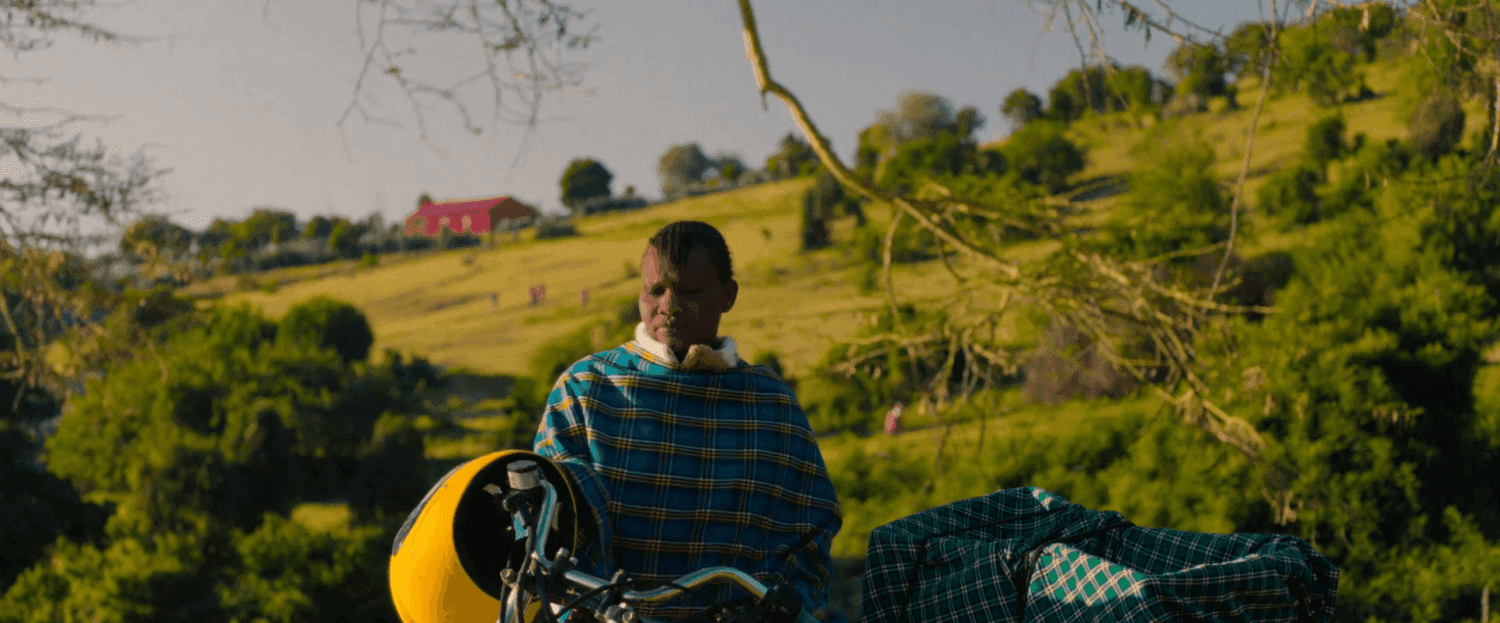
One Woman One Bra follows the trials and tribulations of Star – played conscientiously by Sarah Karei – an ostracised woman gliding through her Maa community on her boda boda, with no kin of her own. The women around her couldn’t imagine living without children, let alone a husband, yet for Star, the film hints that she rejected an old man’s proposal. For the most part, Star is comfortable in her solitude, that is, until the distribution of title deeds based on family ties puts her isolation at a disadvantage that threatens to leave her homeless.
What begins as a rush to establish her lineage devolves into a series of attempts at survival without ever fully defining what family, tradition or even personal identity means for Star or the women of this little village. The only steadfast character is another young woman hustling at a shop at the beginning, with everyone else seemingly shifting depending on what the story needs of them.
The film prides itself on the close proximity of its narrative to the lives and topography of the people of Loita, where it was shot, and it is the people of this community who emerge as the standout of the production. The little moments where each gets to have their 15 seconds of fame in front of the camera bring genuine smiles. And while the use of local non-actors sacrifices some of the technical nuance in performance, what they provide in turn is wholesome levity and spirited personality that ignite their sparse dialogue with liveliness.
Moreover, in between the spaces these characters inhabit, Nchogu and cinematographer Muhammad Atta Ahmed do their best to capture the vast expanse of land and visual iconography of the Maa plains, elevating even the most monotonous scenes into a heightened experience. Though the sets and locations are minimalistic, giving much of the B-roll and intermittent scenes a documentary feel, one never gets a sense of visual restraint. In almost every scene, the camera lingers long after the characters, allowing the landscape and physical space to carry what the performances sometimes cannot.
One Woman One Bra plays into a satirical exploration of the white saviour complex and the backhanded funding from foreign institutions, pulling Star into a spiralling path as she seeks out a white man who documented a part of her past, while also trying to find her place in her community. She is constantly admonished but also tolerated by everyone around her; her every attempt to be a part of the community ends up alienating her even further.
For a while, the film finds its stride in its hilarious portrayal of the “One Woman One Bra” campaign, as Star leads the women into what they believe is a quick money-making scheme, only for it to end with them having more bras than they know what to do with. In trying to save her home, Star has to sacrifice everything she has, including her boda boda and her rejection of marriage, and by the end, question everything she had been fighting for.
One character remarks at some point, “a child who is scorned by the community ends up as a source of chaos.” Star as the source of that chaos provides some fitting comedic moments, but zoomed out, it doesn’t paint her character, her community or the film’s thematic sentiments in a good light. Despite spending much of its runtime reiterating her goal, the film is made up of too many instances where Star – and the direction of the film – becomes too distracted to build upon the few pieces that work.
What starts off as a satirical take on pandering to the foreign gaze ends up painting its main character as an indecisive pushover, resourceful in short bursts but devoid of an endearing arc. The Maa people, meanwhile, are shown as vindictive and often ignorant of the plight of one of their own for seemingly no other reason than to further isolate Star.
One Woman One Bra is a fun film, provided you filter out much of the sensitivities of modern narratives. It feels very much like a film that could have been made years ago, with a simple enough plotline about a woman coming into her own, and the aloofness of African culture setting up comic relief against its critique of foreign influence.
There is an irony, then, in how differently One Woman One Bra might play to different audiences. For foreign audiences, this is the kind of film that would vindicate how they see traditional African cultures while entirely missing the satirical punches jabbed at them. For the Kenyan audience, meanwhile, it is a film that would be celebrated for decentralising the urban narrative monopoly and therefore forgiven for not matching the standards of other national productions.
One Woman One Bra is screening at Anga Cinema Diamond Plaza and Prestige Cinema.
Source: sinemafocus.com