
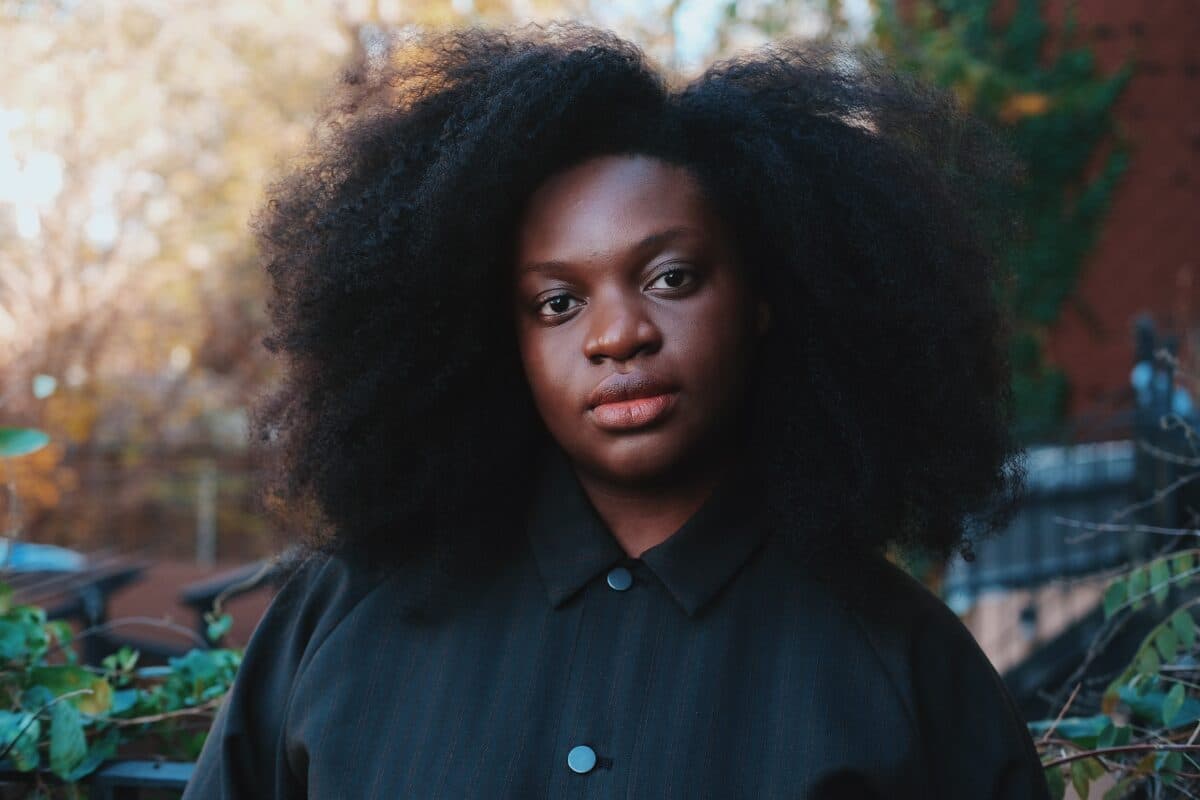
It is probably hyperbole to say that nobody has ever gotten to their first Sundance screening in the way that Praise Odigie Paige has. But it might be true.
A few years ago, she was an undocumented person in the US. Go back some years and she was a 10-year-old kid who had just moved to the US. Go even further and you'd find a kid growing up in Ibadan, Nigeria, raised by Esan parents in a family where nobody would have known that this child would be showing Birdie, an impressive short film about two immigrant daughters and a stranger from home, to a crowd of filmgoers at the 2026 edition of the Sundance Film Festival.
The day we speak, she is a figure on a screen with bright eyes and full, wild hair. The “writer-artist-filmmaker”, as she describes herself, is about as bubbly as her film is restrained, a gorgeous tightly written picture she wrote and directed herself. By way of a bio, she says she enters every story through “the lens of poetry even though I don’t write poems” and then says she had been living “precariously until recently”. This is how her previous status as undocumented gets into the conversation.
Obviously too young to understand what was happening at the time, Odigie Paige recalls her family receiving a letter with an ultimatum: they had 30 days to leave the US. “Clearly, we did not leave,” she laughs.
But even without grasping what exactly the problem was, she grew up with a sense of dread, which then became a feeling of being caged, given the impossibility of travel for the undocumented. She tells me that in recent years, she has had dreams where she’s hustling to go back to Nigeria in a manner similar to the harried manner her parents left their home country. (Somehow, her folks had missed their flight and were then given five minutes to get on the plane that eventually took them to the US.)
The Immigrant
In the US, Odigie Paige was going to become a popular immigrant cliché: she would study medicine and become a doctor. That changed when an aunt visiting from Nigeria expressed surprise at her course of study. Her aunt’s admonition didn’t immediately change her path, but when that aunt passed on sometime around 2011, she realised that “time can be wasted” and decided to give her love for storytelling a chance. This, assures me, is an abridged version of a much longer story. “There was so much pressure being the first of my family to go to college here, I felt I needed to do something ’serious’ with it but I just made a decision to do what I was born to do and that was film.”
Her complex journey links the emotional stakes of her Sundance short to her life. Birdie, she says, is seeking an answer to the question, “What does it feel to be separated from home…especially as a child?”
In writing the story, though, she was drawn to Nigeria’s history. It is why the film is set in the late sixties, during the Biafran War. But there is more to the story; in addition to the wartime immigrant perspective, there is also a sexual awakening of sorts for the film's central character and what that experience does to the relationship between two sisters and between mother and daughter.
“The film is about your adolescence unfolding in the shadows of these adult catastrophes that no one really explains to you,” she says, adding that even as many things were happening when her family landed in the US, she most clearly recalls the feelings she and her sister had as they grew into their bodies.
“I am drawn to how displacement presses into private lives,” she says. “And things like shame and desire were a big part of my coming-of-age experience. But Birdie is also about a mother figuring out what it means to be unprepared in a time she can’t control.”
In the short film, the title appears to be a shortened version of Bernadette, the name of the film’s elder daughter (Precious Maduanusi). But there’s another reason it is titled so. “These are teenagers who just want to be free.”
Odigie Paige makes no real attempt to hide how much of her life is in the film, so I ask which of the film’s two girls represents her youth. It should be easy enough to say it is the one who gives the film its title and whose behaviour propels the plot but there’s a crease in that theory. Birdie’s story is narrated by her younger sister (Eniola Abioro), a Nick Carraway figure whose name is unsaid in the film.
“When I started the film, it was more from Birdie’s perspective," she says, "but as people started to ask me about the story, I realised I wasn’t the sister who was making all these bold and risky choices. I was the one who was very mousy, who was obsessed with validation of my parents. I was the one standing in the doorway and trying to keep my sister in line.”
Shooting Birdie
The film was shot in Virginia in late 2024 during the American elections. “Appalachia,” she says. “Very rural.” To get her actresses, she went to different sources. She discovered Maduanusi on a casting website called Backstage. She wasn’t sure what character she’d play but she knew she wanted her for a role. She found Abioro on Instagram. Sheila Chukwulozie who plays mother to the daughters was found in a short film titled Egungun. Coincidentally, that film's director, Olive Nwosu, showed her debut feature, Lady, at Sundance this year.
While Chukwulozie and Maduanusi are Igbo, Abioro is Yoruba. Odigie Praise is herself fully Esan—her mum is from Uromi; dad is from Iruekpen. She got married in 2019 and turned her original last name to her middle name. “I am the first born,” she says. “That name has to live on.”
Given the sensitivity of some Nigerians to matters concerning ethnicity, did she consider telling a story directly connected to the Biafra War a problem? She says she thought about it and decided that her “writing came from an honest place” and it was rooted in her own “personal experience”. It also helped that she grew up with in an environment with a lot of Igbo people. She adds that she partnered with the right people so when they said they felt “seen, that was enough validation that I was telling the story correctly”.
There's no stopping her now. There's a feature film also involving Biafra in her future. She tells me that Nigeria’s main war is a “story that needs to be told and be told in a specific way”. To tell it, she would “focus on the emotional cost of war on women—young women, older women”.
Birdie’s cinematography, one of its highlights, was commandeered by Lidia Nikonova, with whom she was to work with on a previous project that didn't work out. For Birdie, the pair went over the story's emotional notes for months. “Lidia brought a repertoire of references that became my references too,” she says.
Those references include works from Lucretia Martel, Ousmane Sembene’s Black Girl, and Djibril Diop Mambéty's Touki Bouki. I tell her that her film's juxtaposing the lives of two sisters, one of whom has a sexual experience, recalls Ian McEwan's 2001 novel, Atonement, and its Oscar-winning adaptation by Joe Wright. To this, she exclaims, “Oh my God!" Apparently, one of her actresses had mentioned the same film to her the day before we speak. "I read the synopsis," she says. "That’s a great reference.”
To get to Sundance, Odigie Paige’s team applied in August 2025 with an incomplete film. “It felt like a long shot,” she says, so she perceives her acceptance as an offshoot of the festival's rectitude. “It speaks to the integrity of the process."
The good news from Sundance was delivered in November, which spurred a bit of frenzy. The film needed to be complete within a few weeks. In the end, it took what the director calls a “very stressful month” to get it ready for its premiere in January.
The Sundance Screening
As anyone can imagine, Odigie Paige was nervous at the first public screening of the film. But she had no reason to be. The film was well-received.
“The premiere was so much more rambunctious that I imagined,” she says obviously elated. “I think they fell in love with the characters.”
Indeed, the enthusiastic reception assures her that there is an audience for Birdie and her future work. “People get the film," she tells me. "We are a global audience of cinephiles and we can appreciate things that are critical and thoughtful even if it’s not extremely genre like comedy or romance.”
In making her film, she says she wasn't trying to pander. “I will never make a Nigerian film to be positioned for an American audience. My goal is specificity. But it is interesting that the more specific your story is, the more you cross to a large audience.”
While on the subject of her Sundance reception, she notes her happiness at seeing people from her home country at the festival. “It is cool to have a community of Nigerian people showing up for Lady, showing up for Birdie.”
To close the interview, I ask what an ideal Sundance outcome would be. She responds readily. “Funders find me,” she says. “Development execs find me. We need money to tell these stories well.”
And with that she laughs, a brief full-throated, delight-carrying laughter.
Source: filmefiko.com