
One year after camera giants Nikon and RED Digital Cinema merged, their first collaboration comes with the release of the Nikon ZR full-frame digital cinema camera. The ZR differentiates itself from its mirrorless competitors—whether Panasonic’s LUMIX line, Sony’s FX line or Blackmagic cinema cameras—with its unique ability to record 12-bit REDCODE RAW (R3D NE), internally at up to 6K and 60 frames per second. And it’s available at the enviable price point of only $2,199. (By comparison, Sony’s full-frame FX3 costs nearly twice as much.)
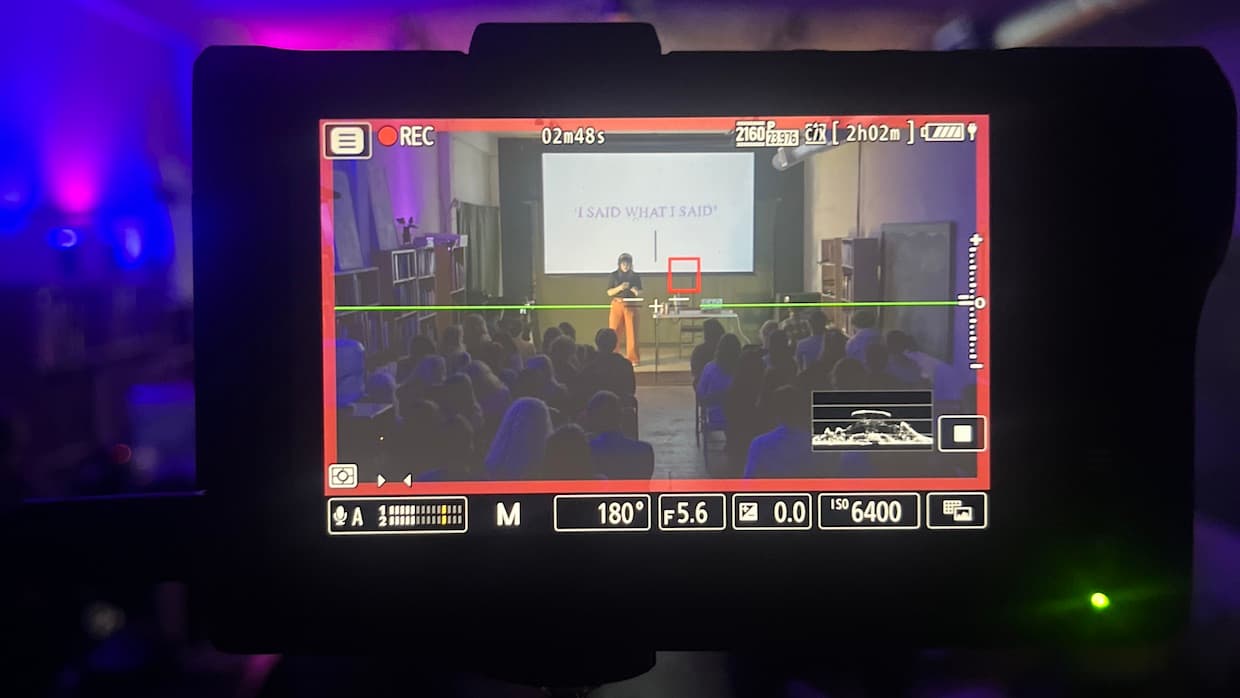
Surveying the camera body, its large 4-inch screen immediately stands out. The addition of an external monitor—typically a must when shooting on smaller cinema cameras—becomes less essential with the Nikon ZR. This screen brightness reaches 1,000 nits, making it easily visible when shooting outside in broad daylight. The camera menu has been reworked from Nikon’s previous Z cameras and is user-friendly, aided by the size of the screen. Similar cameras with smaller screens can be cumbersome when adjusting settings. It’s light at 1.9 lbs, and despite its lack of an internal fan distributes heat well. While testing the camera for an interior event, the body was warm at the end of the continuous four-hour shoot, but not overly so. Booting up in a flash, it’s ready to grab candid shots at a moment’s notice. Its Auto mode quickly adjusts to lighting conditions and engages autofocus without incident. Nikon’s lauded In-Body Image Stabilization (IBIS) is present with 7.5 stops of range.
For filmmakers used to compressed 4K workflows, recording to RED’s proprietary compressed RAW 6K format opens up latitude for reframing, stabilization, and more detailed color work in post-production. Shooting this R3D NE codec is possible only in Manual mode, which requires fully reformatting the card when switching from the other five codecs. These include N-RAW, ProRes RAW HQ, ProRes 422 HQ, H.265, and H.264. A common misconception is that R3D NE is set-and-forget, since the image captured contains a massive dynamic range and high-resolution sensor data that can be adjusted endlessly later, but in actuality, getting everything dialed in prior to shooting allows for this aforementioned flexibility in post. Depending on whether shooting interiors or exteriors, RED’s baseline ISO of either 800 or 6400 is recommended, for instance. A host of online resources and tutorials help beginners prepare to shoot in R3D NE by laying out these recommended settings.
The absence of external SSD recording capabilities is notable, as cinematographers will often use these drives across competing mirrorless cameras as needed. Instead, the ZR currently requires all RAW recording to CFexpress Type B cards. While Type B media is now widely adopted across Canon, Panasonic, and Blackmagic systems, the ZR’s bottom-mounted card slot next to the battery makes swapping it out a chore whenever the camera is mounted to a tripod or a rig. It’s a puzzling placement that is hopefully corrected in upcoming models. Other features sing: it supports 10 internal 3D LUTs, and the internal 32-bit float audio impresses. And it’s not just that R3D NE codec that delivers. A century-old camera company, Nikon simply possesses the science to deliver a pleasing image across all its RAW codecs. As does RED Digital Cinema, which is one reason RED is the camera of choice for David Fincher’s Academy Award-winning DP Erik Messerschmidt.
With its compelling price point, accessibility and RAW capabilities, the Nikon ZR is a promising start for this ongoing collaboration between Nikon and RED. It should appeal to filmmakers well-versed in prosumer mirrorless cameras who are curious to dip their toe into the RED world with its superior codec, especially since getting one’s hand on a traditional RED cinema camera is not always feasible for the budding DP.
Source: filmmakermagazine.com