
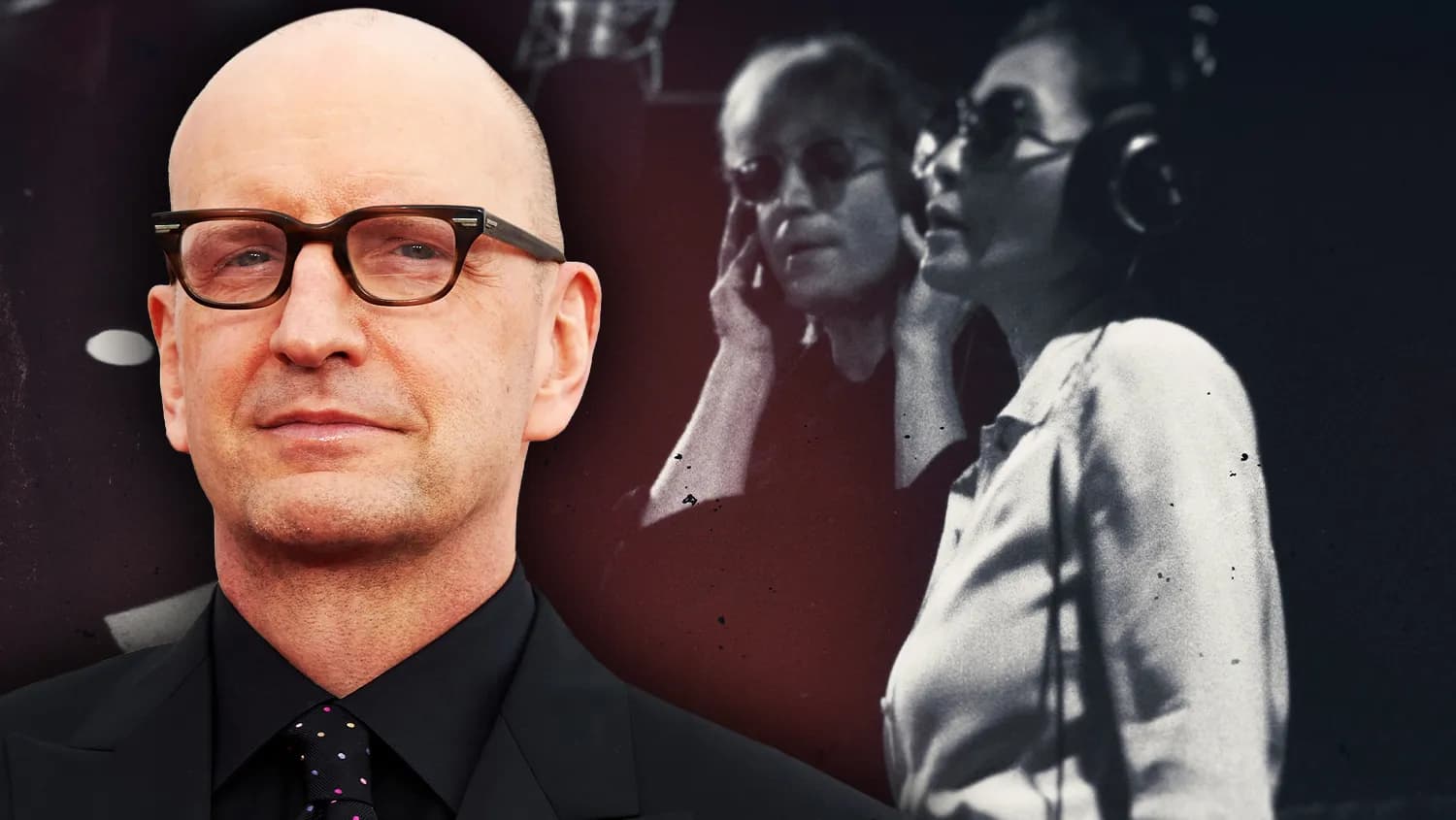
Not long ago, Steven Soderbergh was presented with a singular opportunity: exclusive access to the final interview with John Lennon, recorded mere hours before his death, as the foundation for a documentary.
Never before released in full, the interview finds Lennon sitting down at home with wife and creative collaborator, Yoko Ono, and an RKO Radio team to discuss Double Fantasy, the album he didn’t know would be his last. Candid, reflective and deeply engaged, Lennon and Ono move fluidly between the personal and the philosophical over the course of the conversation — from partnership and parenthood to their art and hopes for the future. Related Stories Casting Alfre Woodard, Toni Collette, Chloe Coleman & Sagar Radia Join Joseph Gordon-Levitt's AI Thriller For Netflix & T-Street News 'Stop! That! Train!' Director Calls Claims He Used AI To Make Film "Patently Not True"
For Soderbergh, the mission with the doc was clear: to offer the most intimate access possible to two of the world’s great artistic minds. Letting the interview dictate the doc’s structure, he labored to preserve the substance of the conversation while paring it back from its near three-hour runtime. Watch on Deadline
To Soderbergh, these reactions are understandable, underscoring the need for transparency from artists about how and why they’re utilizing AI. And that’s precisely what he provides in this interview with Deadline — his first in-depth conversation about the Lennon doc, ahead of its Cannes premiere, where he gets into the specific sequences AI enabled, the iterative process by which they were developed, and the creative and ethical framework behind his use of the technology. Soderbergh at the same time reflects on the enduring relevance of Lennon and Ono’s words, the Beatles as a “clinic in creative evolution,” his ambitions of returning to the arena of large-scale event filmmaking, and more.
DEADLINE: How did the John Lennon interview come to you? And how did you come around to the idea of building a film around it?
STEVEN SODERBERGH: I got a call from [manager/producer] Michael Sugar saying that there was the possibility of a documentary being made around this interview that John and Yoko gave the day he was shot. And would I be interested? He’d been contacted by the producer who controlled these rights and I listened to the interview and said yeah. I mean, I didn’t have to think too much. I wanted to make sure that its sonic quality was good, and it is. It’s shockingly good. And also I was curious to hear what they had to say. It was quite a long piece: I think the whole interview is about two hours and 45 minutes. So that was a hell yeah.
The producer, Nancy Saslow, and I started having conversations, and first order of business was, we’ve got to get this interview down to a manageable length. And that was tricky just because it was all interesting. And I wanted to respect the chronology of the conversation because I felt there was a sort of structure and a flow that we needed to respect. So that took a little while, to get the audio cut done. Then, we began to lay in the interviews that we shot of the journalists talking about their experience of being in the room with John and Yoko, their expectations for the interview, and then obviously their descriptions of what happened after.
So now we’ve got it kind of laid out in chapters and we begin to fill in the areas in which John and Yoko are speaking about a specific experience that they had, or a specific piece of music, or a specific person, and layer in archival material over that text — sometimes stills, sometimes motion, video. Stills are cheaper, so we were leaning towards stills. Because this is all, at this point, being independently financed by some funds that Nancy has gotten together. And we have a version of the movie in which the only holes that remain now are the sections where John and Yoko are talking in abstract philosophical terms.
This comprises about 10% of the entire film, but it’s a real problem because we’ve got to come up with something — some imagery that enhances what they’re saying, but is metaphorical. So we’re starting to experiment with AI, trying to see if we can build some images that’ll fit alongside this text. I’m trying to articulate ideas that will result in something interesting, and we’re running out of money.
So at this point, Michael Sugar says, “Look, I’ve been doing all this work with brands making content. I think we should have a conversation with Meta because they’re building some video generative tools.” And I said, “Fine, let’s talk to them.” They were open and wanted to see the film, so we showed them the film and they said, “Well, this is good timing because we really would like and need a filmmaker to stress test some of these tools that we’re working on. And if you agree to be a test case for us, we will provide the tech and finish the movie.” So I said, “Yeah, let’s do that.” And that was kind of the last stage, was building these sequences that have images that are impossible to shoot.
DEADLINE: Backing up for a moment — how would you describe your personal relationship to Lennon, Ono and The Beatles? Beyond the outsized space they occupy generally in music history and the popular imagination.
So they were influential in two different ways. And then I think for a lot of people, John was someone who just spoke the truth all the time. And that also seemed like something worth emulating. Whether you agreed with him or not, you couldn’t doubt his sincerity in what he was saying.
So I was very concerned that if we were able to convince Sean [Lennon] and Yoko and the estate to cooperate, to let us do this, and to help us make this movie, that we wouldn’t disappoint them. I’m used to self-imposed pressure: I want things to be good, but this was different. This was different than, I’m making a movie for a studio, and I want the studio to be happy with the result. That’s true. But this felt very personal and much more loaded for me, I think for all of us. We didn’t want to let them down.
DEADLINE: Did you personally sit down with Sean and Yoko to discuss the project?
SODERBERGH: No, we met with Sean and Jonas [Herbsman], who’s in charge of the estate, and described in detail what we were planning to do.
DEADLINE: So what did it take to earn their trust in this project, such that they’d open up their incredible trove of music and archival material for your use?
SODERBERGH: Honestly, I think they were just trusting us. My resume, Nancy’s resume, Sugar’s imprimatur. I think they liked the creative team, and even though they expressed no interest in being involved creatively… I had a sense of the sensitivities involved here, especially because Sean is part of the movie. He’s a very important part of the movie, and so I was very anxious that we be accurate. Because Sean is very like John in the sense that he just wants it to be true. He doesn’t present as someone who’s trying to protect anything other than what’s actually true. That’s why I felt the edit of the interview was crucial because I wanted you to get a real range of opinions and emotions.
That’s what really surprised me about hearing the interview, was how excited they were to talk about everything and anything. You’d think listening to them that they’d never been interviewed before. They had like no filter at all. They’re just riffing. And because of the quality of the recording and where the recording’s taking place, the feeling of it, the prosody is tangible. You can hear the intimacy of the room and the conversation. So again, our job is to come up with visual strategies for each of the chapters so that the movie feels like visually it’s evolving as it goes on, but not in a way that’s distracting, and assist in or enhance this feeling of intimacy, of being in the room with them as much as possible.
[The film’s] only been seen by a few people. I’m very curious to have audiences see it because I find the last eight to 10 minutes extremely wrenching. There’s an interesting thing that happens, I realized, when I started watching it end to end: You’re so engaged with what they’re saying, you forget what’s coming. And when you are reminded of that in the last section, I find it very emotional.
DEADLINE: What else did you find striking or surprising about what we hear from Lennon and Ono?
SODERBERGH: That everything in their lives, one way or another, was motivated by love. For both of them, initially, [of their] art. The love of their art was stronger than anything else in their lives, including the people around them. Then they meet, and it’s a while before they get together. But when they get together, they’ve each found someone that they love as much as they love their art. So what I enjoy about listening to this interview is you understand why they’re together, you understand what a great story it is that they found each other. And that for John, the five years from Sean being born up until the day of this interview were the happiest years of his life.
DEADLINE: Let’s talk about the AI of it all. You’ve highlighted the use case — the creation of surrealist thematic material. But can you walk us through a couple of sequences and illuminate your process a bit?
SODERBERGH: First of all, I think obviously, this is a very emotional subject lately. Understandably so. When I think about it though, I try to think about it in two different contexts. There’s the AI that is part of the informational ecosystem of the world and affects things like war and politics and culture. And then there’s the AI that exists in a creative context that is used as a tool, which also can affect culture. Then, within that, there are two ways of using it. There’s a way of using AI in which your intention is to fool somebody or manipulate them, to create an image that you want them to think is real. And then there’s a use, which is what we’re doing in the documentary, where it’s obvious that it is AI and that it is being used essentially in the way that you would use VFX or CGI or any sort of non-photographic technology. And the reason that that turned out to be perfect for us is really exemplified by two sequences that I think I’m not spoiling anything for anybody by talking about.
And the same thing with this other instance where we have these cavemen acting out some of the things that John is discussing when it comes to male behavior. Going out and shooting those images of men dressed up and made up as cavemen doing the things that are in this sequence: not as funny. It’s funnier if you know it’s not real.
I think people, when they heard about this project and that I was using AI tech, jumped to the absolute worst conclusion, which is, “He’s going to try and bring John Lennon back to life.” And all I can say is, have we met? Do I look like somebody that would do that? So it’s a little hard to talk about also because I feel once you’ve seen the movie, you go, “Oh, of course.”
SODERBERGH: I just think a lot of the emotion that is legitimate about AI, in a non-creative context and how it’s affecting our lives, it’s understandable that that would bleed into a conversation about a movie. But I know that talking about it is good. And I know that we don’t know how this is going to play out.
DEADLINE: I guess what I’m trying to articulate is that there’s been a public shaming online with regard to AI use — people have rushed to judgment on your work, for example, or Darren Aronofsky’s, before really understanding what the work entails…
SODERBERGH: Look, I’m pro-choice. If that’s your position, if you don’t want to work with it and you don’t want to work with people or companies that work with it, then go that way. I want to know what we’re talking about, what these tools are. I want to know what they can do and what they can’t do to determine whether this is a threat or not. It might be a bubble, we don’t know.
Here’s what I do know. I asked Sean, “What do you think your dad’s take on this tech would’ve been?” And he said, “Oh, he would’ve wanted to engage.”
He loved all new technology. All The Beatles did. He would want to play with it just to see what it could do. He goes, “That was the way he was. ” How he would’ve felt about it ultimately, we’ll never know, but he said he would’ve wanted to play with it.
DEADLINE: Where does that impulse come from for you? Because you’ve been forward-looking for your entire career, always experimenting with form.
SODERBERGH: Well, part of it is what I said about looking at the Beatles’ creative process over the years they were together, and part of it is just a desire to have each experience be different from the last. But ultimately, I’ve got a post-it on the monitor here in handwritten all caps: “BETTER.” This is what I’m always trying to accomplish. I want to be better at what I do; I want the thing I’m working on to be better.
DEADLINE: Would you say you have a fascination with technology?
SODERBERGH: It’s funny, I wouldn’t say that. In a creative context, it interests me because of the tools that it makes available and the fact that that makes it easier for me to do what they say at Pixar — be wrong as fast as you can. All this technology allows me to get to a version of the thing faster so I can tell whether it’s working or not, and that’s invaluable to me. So I think that’s the pull of the technology to me, is can I get a version of the thing in front of me faster? Outside of this context, I don’t have a lot of tech and don’t use it for my personal life.
DEADLINE: Can you elaborate on your methodology on this film, with regard to the creation of AI material? What did your prompts sound like?
SODERBERGH: I’m sure if you talk to the people that I was working with, it had to have been frustrating. I’d say things like, “opening shot of the film, I need a ’50s-style radio. I want you to create some rings that will pay off later. This will be a recurring motif, these kind of light rings. But for now, there are these light rings and then this radio comes out of nowhere and comes up and fills the screen until it whites out.” And they go, “Okay…” And then they’d come and show me versions and I would go, “Slow it down, make the radio bigger,” or whatever. I might say, “Show me an image of a piano being blown to bits, backwards, in the style of a crash test dummy film.” There’s one section where I’m like, “Okay, take those rings that we were talking about, light rings. Now, those are water rings because there are drops going into water. So they turn into water rings. And then there’s a black rose, and then I want the black rose to rise up and become these other roses, like a Busby Berkeley top shot.” It would be sh*t like that.
Source: deadline.com